
For this week, I decided to talk about Guillermo del Toro’s fantastic film Pan’s Labyrinth. First things first, I just want to make it clear that I am a huge fan of del Toro’s work (and even more since he’s Mexican). It’s not certain yet but for the next few weeks, I want to continue talking about two other films by del Toro because I really want you to get to know his amazing films. To start things off, I wanted to explore Pan’s Labyrinth and deeply analyze everything that is happening in the film especially since there are two stories happening simultaneously. The way Del Toro presents both stories with different color tones helps the viewer understand the difference between the fantasy world and the dark ordinary world set during the Spanish Civil War.
In simple terms, the film is a fairy tale. We have Ofelia, an ordinary girl, who meets a faun that tells her she is a princess. In order to return with her family as the princess she is supposed to be she must complete a set of tasks to prove her worth. These tasks are to obtain a key, a dagger, and a last one that I will not mention. The way Ofelia completes these tasks will prove if she’s worthy or not and if she really is a princess. Although a fairy tale, it is far from the Disney fairy tales we are used to seeing. The faun and the fairies are never really good nor bad and it is up to the viewer to decide. We never fully trust the faun’s intentions and at some points of the film it even appears that he is simply trying to trick Ofelia. The film’s opening sequence itself shatters the notion we have of fairy tales. Disney has managed to transform fairy tales and make us used to happy endings where everything turns out perfectly for the protagonist at the end. In this film, del Toro breaks away from stereotypical fairy tales since the very first scene by showing the protagonist, Ofelia, laying on the ground as blood is slowly dripping from her body.  We can already assume that this “fairy tale” might not have the happy ending we hope it deserves.
After we catch a glimpse of the dying Ofelia, we then go back in time to the start of Ofelia’s story as she arrives with her mother to Captain Vidal’s house. The house plays a pivotal role since the entire film is set here and we only see different settings from the fantasy sequences. I believe this was done so we could see how the Spanish War affected the people at the time. It isolated people and therefore raised tension between family members. This can be further seen through Captain Vidal and his actions. In the film, Vidal serves as the villain; the bad guy that Ofelia must overcome. In a fairy tale sense, Vidal resembles the “big bad wolf” and towards the end of the film, Vidal has fully transformed into a monster. This causes Ofelia to take certain actions that, depending on how you view the ending, harm or benefit her.
Aside from the film’s opening sequence, there are various points throughout the film that also break away from classic fairy tale stories. One of the scenes that served as a perfect example of this is my favorite scene, the one where Ofelia meets The Pale Man. In this scene, we see The Pale Man eating the fairies that served as a conscience to Ofelia, something a classic Disney film would never show. We also see a pile of children’s shoes in a corner of the room implying that The Pale Man has taken the lives of many innocent children.
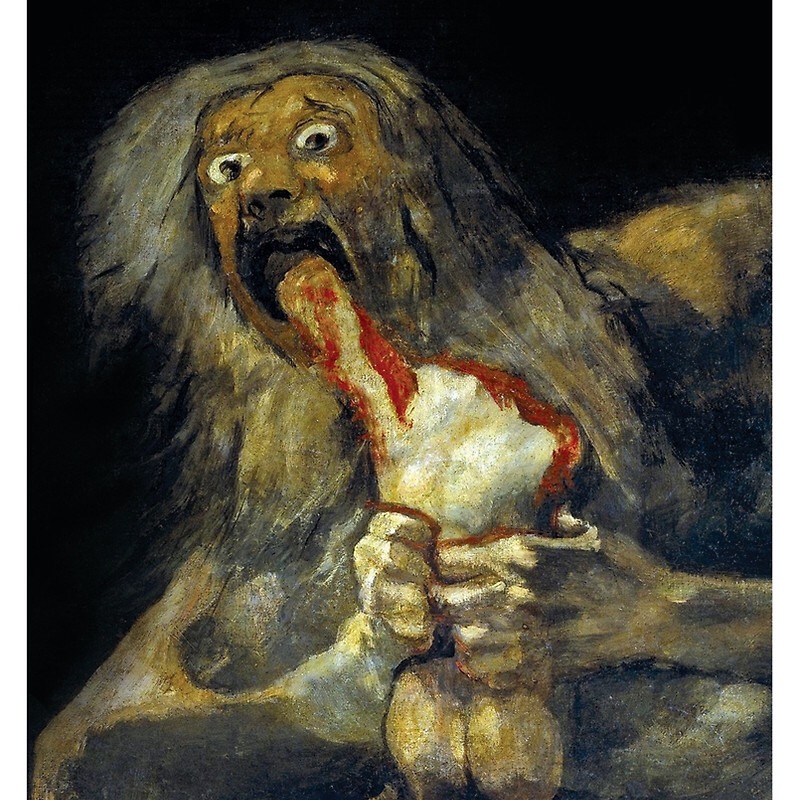
Fun fact: Franciso Goya and his painting Saturn devouring his son served as the inspiration behind The Pale Man
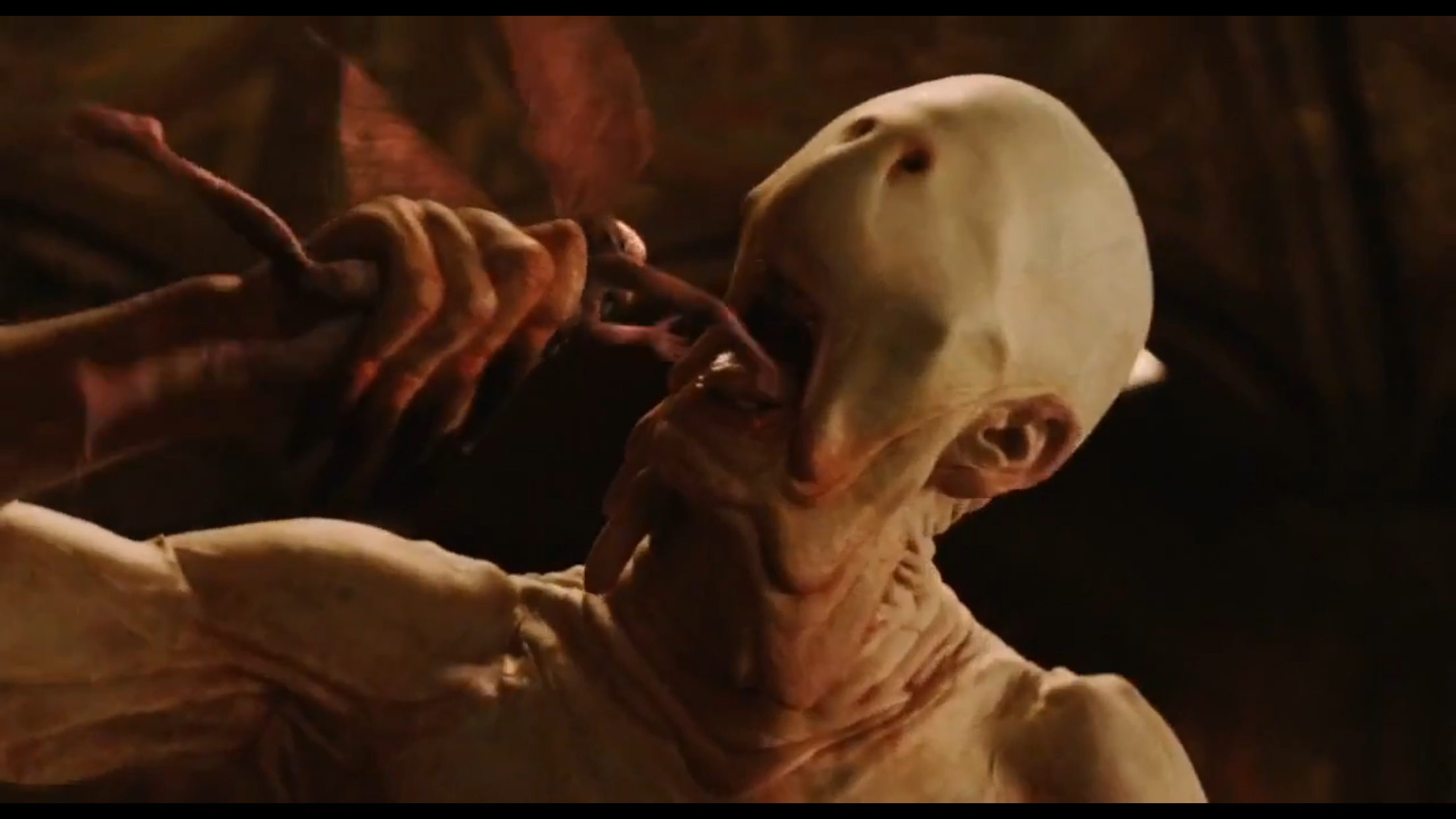
Ofelia defies the rules that were told to her and because of this, two fairies pay the price. She still manages to escape despite disobeying the faun. This in my opinion gives Ofelia the strength she needs to follow her instincts, which will help her towards the end. (Pay attention to the the mise en scène, or the scene’s arrangement, because this scene resembles the dinner scene with Captain Vidal sitting in the same spot as The Pale Man.)
Like my other posts, I don’t want to ruin the film by providing all these spoilers. There are so many things I want to talk about that it’s hard for me to check off every point without ruining the film. So please bear with me if I ruin some parts but hopefully after reading you will still want to either watch it again or for the very first time. I do want to talk about the ending however and what it could mean. As Ofelia is running away from Vidal to meet up with the faun, we see her arguing with the faun regarding the last task. We clearly see the faun through Ofelia’s point of view. When Vidal approaches Ofelia and the faun arguing however, the faun is nowhere to be seen. This brings the idea that perhaps all these fantasy scenes are in fact simply just in Ofelia’s head. If you decide to watch it keep in mind that shortly before this scene, Ofelia puts the medicine that her mother was taking to sleep inside Vidal’s drink. This leaves open the question of whether or not we can trust Vidal’s point of view. We then see the same scene as the beginning but we now understand that Ofelia chose this path. In a sense, she did believe she obtained her happy ending and it is up to the viewer to decide if this is in fact true.
This is why I really recommend this or any of del Toro’s film’s. He pays so much attention to detail that even with a blink of an eye you might miss an important detail. For example in this film, look at how the colors change when Ofelia is in the real world versus the fantasy world. In the real world, we see dull colors. The war has sucked all the happiness from everyone and the gray colors show this. In the fantasy world, we see a much vivid palette of colors and we obtain hope that Ofelia will escape the wrath of the fascist Vidal. Also pay attention to the different shapes. Everything is so linear but if you look hard enough, you’ll see how all these circular shapes appear in the scenes with Ofelia and the faun. 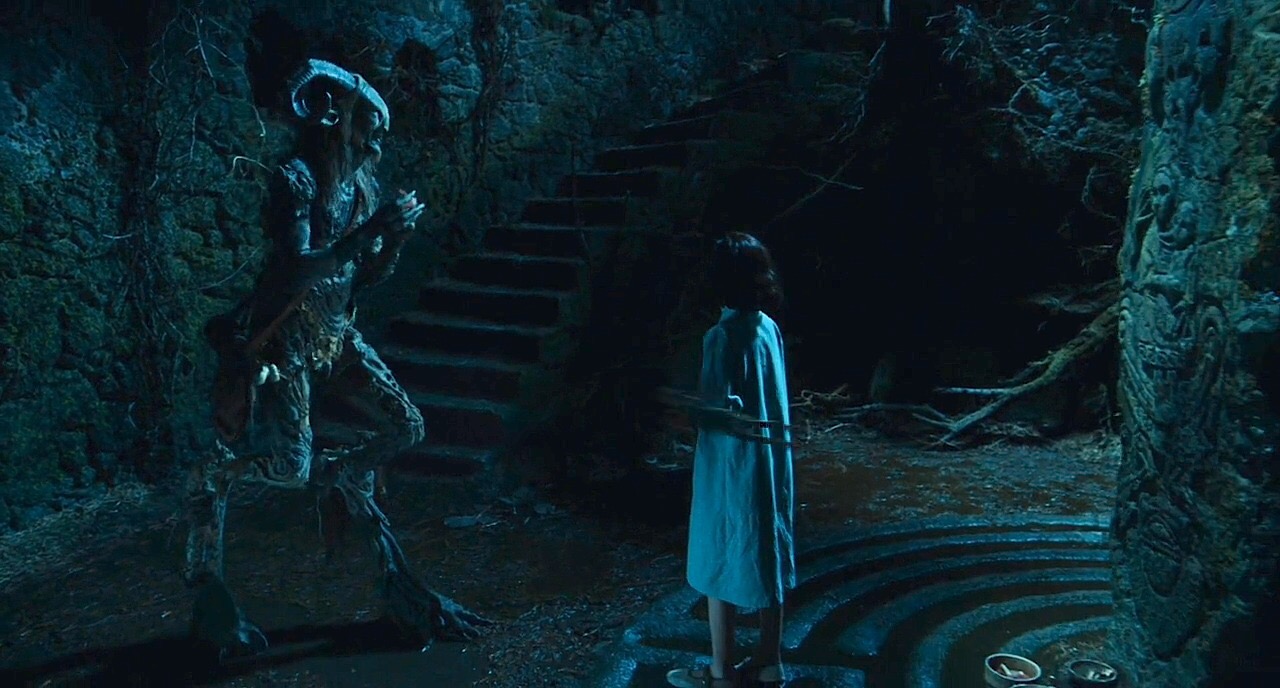
Thank you for reading and I hope you find my thoughts interesting! Feel free to comment your opinions or any questions you have. Stay tuned for more opinions of del Toro’s films.
– Pedro Torres
P.S. This was Mexico’s official submission for Best Foreign Fim at the Academy Awards and although it didn’t win in that category, it did win for Best Achievement in Cinematography, Best Achievement in Art Direction, and Best Achievement in Makeup.

 Pedro's Films